FOGO LENTO
transdisciplinary artistic research
O Tempo das Árvores
A project of research, programming, and creation
2026-2027
The Research
O Tempo das Àrvores / The Time of Trees is an artistic-biological dialogue arising from the encounter between human beings and trees. An encounter between living entities.
“Plant blindness” is a cognitive bias defined by J.H. Wandersee and E.E. Schussler in 1999, describing the inability to notice vegetation within a given environment and to recognize its vital importance to the biosphere. According to biologist S. Mancuso, this is linked to the inner workings of our brain: we fail to comprehend that which is fundamentally different from ourselves. From childhood, we begin to identify and learn the names of animals, yet we neglect plants, which dissolve into an undefined green blur. According to quantum mechanics, reality is relational: it is not that objects exist in relation to one another, but rather that relations themselves give rise to the notion of the "object": “we, like waves and all objects, are a flow of events; we are processes that, for a brief moment, remain monotonous” (C. Rovelli).
The questions that initiate this process of research and creation are: “who am I when I relate to a tree?” and “who are we when we relate to a forest?”. Engaging with a tree compels us to rethink our conceptions of time, scale, movement, sexuality, and individuality, prompting a reflection on a myriad of deep-seated assumptions.
O Tempo das Àrvores will be an interdisciplinary research process in which we seek to weave connections between human and plant life, through a dynamic encompassing observation, mimicry, repetition, care, germination, sharing, encounter, and exchange.
Throughout the process, there will be moments of sharing where we seek to transcend the boundaries of each body, each material, and each discipline, through the creation of unconventional relationships.
We envision this creative process as a growing forest: a series of interconnected actions, in harmony with the human and botanical ecosystems in which they are embedded, nurturing artistic objects across various media (exhibition, performance, podcast). Building upon the research developed, we will create a production in 2027 with the working title: "Perder-se no bosque"/"Losing Oneself in the Woods", a work for choir and performers.
Assembleia Vegetal / Flora Assembly
Ongoing Project with Adolescents
“Flora Assembly” — a one month journey involving secondary school students.
Drawing from the study of indigenous trees, we will establish a plant-human assembly, where young participants and the invited public convene to share inquiries and reflections, rooted in the relationship forged with these majestic botanical beings.
A Nossa Borda de água / Our Waterside
A Nossa Borda de água / Our Waterside is an intergenerational gazette to be developed alongside communities of children and the elderly. This publication will curate local botanical knowledge regarding the region’s trees, interwoven with personal experiences, oral histories, and reflections.
Artistic Coordination: Costanza Givone
With: Alex Cassal, Clelia Colonna, Joana Magalhães, Samuel Ornelas.
Partnerships: Biodiversity Gallery and Porto Botanical Garden, National Arts Plan, Amarelo Silvestre, CRL - Central Elétrica, Lugar do Meio.
Supported by:


Município de Vila Nova de Gaia (Pelouro Cultura e Ambiente),
Junta de Freguesia de Pedroso e Seixezelo, Munícipio de Leiria, Compainha Amarelo Silvestre, Lovers & Lollypops,
Universidade do Porto/Jardim Botanico/Galeria da Biodiversidade, ESMAE (Escola Superior de -Música e Artes do Espetáculo,
Agrupamento de Escolas dos Carvalhos (V. N. Gaia)
and ArtsIceland.
Supported by:
Município de Vila Nova de Gaia (Pelouro Cultura e Ambiente),
Junta de Freguesia de Pedroso e Seixezelo, Munícipio de Leiria, Compainha Amarelo Silvestre, Lovers & Lollypops,
Universidade do Porto/Jardim Botanico/Galeria da Biodiversidade, ESMAE (Escola Superior de -Música e Artes do Espetáculo,
Agrupamento de Escolas dos Carvalhos (V. N. Gaia)
and ArtsIceland.
Previous Activities


fotos de João Cruz e Joana Cruz
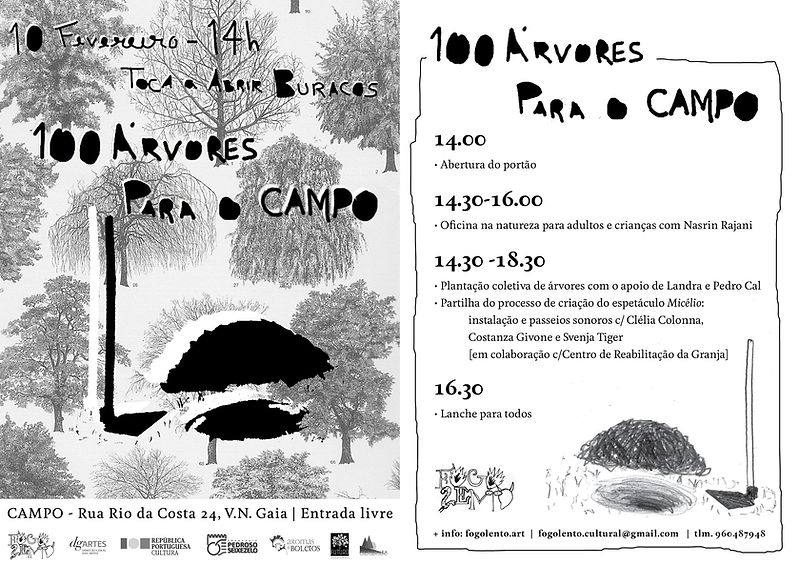
100 Trees for CAMPO
10th of February 2024 at CAMPO (Rua rio da Costa 24,4415-320 V.N. Gaia)


On the 10th of February, we invited friends, neighbours, and all interested parties to partake in the conversion of CAMPO — a plot of land formerly utilized for intensive agriculture — into a sanctuary of biodiversity, by planting trees and fostering the development of mycelium.
Through the support of the company Aromas & Boletos, we planted 50 mycorrhizal trees (whose roots had been pre-inoculated with mycelium), while the remaining 50 were provided by the 100,000 Trees project. The saplings were welcomed into the terrain with the invaluable guidance and expertise of the Landra collective, landscape architect Pedro Cal, and filmmaker João Vladimiro.
Our heartfelt gratitude to everyone who contributed to this day!
On this occasion, we also shared the work developed at Play - Brincar para Crescer, the Granja Rehabilitation Centre, and the Carvalhos Fair — all integral components of the creative process for the performance "Micélio," set to premiere this September at the Gaia Municipal Auditorium. Pedagogue Nasrin Rajani facilitated a workshop for parents and children, while artists Clélia Colonna, Costanza Givone, and Svenja Tiger presented a site-specific piece conceived for CAMPO.
O Tempo das Árvores
A project of research, programming, and creation
2026-2027
The Research
O Tempo das Àrvores / The Time of Trees is an artistic-biological dialogue arising from the encounter between human beings and trees. An encounter between living entities.
“Plant blindness” is a cognitive bias defined by J.H. Wandersee and E.E. Schussler in 1999, describing the inability to notice vegetation within a given environment and to recognize its vital importance to the biosphere. According to biologist S. Mancuso, this is linked to the inner workings of our brain: we fail to comprehend that which is fundamentally different from ourselves. From childhood, we begin to identify and learn the names of animals, yet we neglect plants, which dissolve into an undefined green blur. According to quantum mechanics, reality is relational: it is not that objects exist in relation to one another, but rather that relations themselves give rise to the notion of the "object": “we, like waves and all objects, are a flow of events; we are processes that, for a brief moment, remain monotonous” (C. Rovelli).
The questions that initiate this process of research and creation are: “who am I when I relate to a tree?” and “who are we when we relate to a forest?”. Engaging with a tree compels us to rethink our conceptions of time, scale, movement, sexuality, and individuality, prompting a reflection on a myriad of deep-seated assumptions.
O Tempo das Àrvores will be an interdisciplinary research process in which we seek to weave connections between human and plant life, through a dynamic encompassing observation, mimicry, repetition, care, germination, sharing, encounter, and exchange.
Throughout the process, there will be moments of sharing where we seek to transcend the boundaries of each body, each material, and each discipline, through the creation of unconventional relationships.
We envision this creative process as a growing forest: a series of interconnected actions, in harmony with the human and botanical ecosystems in which they are embedded, nurturing artistic objects across various media (exhibition, performance, podcast). Building upon the research developed, we will create a production in 2027 with the working title: "Perder-se no bosque"/"Losing Oneself in the Woods", a work for choir and performers.
Assembleia Vegetal / Flora Assembly
Ongoing Project with Adolescents
“Flora Assembly” — a one month journey involving secondary school students.
Drawing from the study of indigenous trees, we will establish a plant-human assembly, where young participants and the invited public convene to share inquiries and reflections, rooted in the relationship forged with these majestic botanical beings.
A Nossa Borda de água / Our Waterside
A Nossa Borda de água / Our Waterside is an intergenerational gazette to be developed alongside communities of children and the elderly. This publication will curate local botanical knowledge regarding the region’s trees, interwoven with personal experiences, oral histories, and reflections.
Artistic Coordination: Costanza Givone
With: Alex Cassal, Clelia Colonna, Joana Magalhães, Samuel Ornelas.
Partnerships: Biodiversity Gallery and Porto Botanical Garden, National Arts Plan, Amarelo Silvestre, CRL - Central Elétrica, Lugar do Meio.
Supported by:
Município de Vila Nova de Gaia (Pelouro Cultura e Ambiente),
Junta de Freguesia de Pedroso e Seixezelo, Munícipio de Leiria, Compainha Amarelo Silvestre, Lovers & Lollypops,
Universidade do Porto/Jardim Botanico/Galeria da Biodiversidade, ESMAE (Escola Superior de -Música e Artes do Espetáculo,
Agrupamento de Escolas dos Carvalhos (V. N. Gaia)
and ArtsIceland.
Previous Activities
fotos de João Cruz e Joana Cruz
100 Trees for CAMPO
10th of February 2024 at CAMPO (Rua rio da Costa 24,4415-320 V.N. Gaia)
On the 10th of February, we invited friends, neighbours, and all interested parties to partake in the conversion of CAMPO — a plot of land formerly utilized for intensive agriculture — into a sanctuary of biodiversity, by planting trees and fostering the development of mycelium.
Through the support of the company Aromas & Boletos, we planted 50 mycorrhizal trees (whose roots had been pre-inoculated with mycelium), while the remaining 50 were provided by the 100,000 Trees project. The saplings were welcomed into the terrain with the invaluable guidance and expertise of the Landra collective, landscape architect Pedro Cal, and filmmaker João Vladimiro.
Our heartfelt gratitude to everyone who contributed to this day!
On this occasion, we also shared the work developed at Play - Brincar para Crescer, the Granja Rehabilitation Centre, and the Carvalhos Fair — all integral components of the creative process for the performance "Micélio," set to premiere this September at the Gaia Municipal Auditorium. Pedagogue Nasrin Rajani facilitated a workshop for parents and children, while artists Clélia Colonna, Costanza Givone, and Svenja Tiger presented a site-specific piece conceived for CAMPO.
O Tempo das Árvores
A project of research, programming, and creation
2026-2027
The Research
O Tempo das Àrvores / The Time of Trees is an artistic-biological dialogue arising from the encounter between human beings and trees. An encounter between living entities.
“Plant blindness” is a cognitive bias defined by J.H. Wandersee and E.E. Schussler in 1999, describing the inability to notice vegetation within a given environment and to recognize its vital importance to the biosphere. According to biologist S. Mancuso, this is linked to the inner workings of our brain: we fail to comprehend that which is fundamentally different from ourselves. From childhood, we begin to identify and learn the names of animals, yet we neglect plants, which dissolve into an undefined green blur. According to quantum mechanics, reality is relational: it is not that objects exist in relation to one another, but rather that relations themselves give rise to the notion of the "object": “we, like waves and all objects, are a flow of events; we are processes that, for a brief moment, remain monotonous” (C. Rovelli).
The questions that initiate this process of research and creation are: “who am I when I relate to a tree?” and “who are we when we relate to a forest?”. Engaging with a tree compels us to rethink our conceptions of time, scale, movement, sexuality, and individuality, prompting a reflection on a myriad of deep-seated assumptions.
O Tempo das Àrvores will be an interdisciplinary research process in which we seek to weave connections between human and plant life, through a dynamic encompassing observation, mimicry, repetition, care, germination, sharing, encounter, and exchange.
Throughout the process, there will be moments of sharing where we seek to transcend the boundaries of each body, each material, and each discipline, through the creation of unconventional relationships.
We envision this creative process as a growing forest: a series of interconnected actions, in harmony with the human and botanical ecosystems in which they are embedded, nurturing artistic objects across various media (exhibition, performance, podcast). Building upon the research developed, we will create a production in 2027 with the working title: "Perder-se no bosque"/"Losing Oneself in the Woods", a work for choir and performers.
Assembleia Vegetal / Flora Assembly
Ongoing Project with Adolescents
“Flora Assembly” — a one month journey involving secondary school students.
Drawing from the study of indigenous trees, we will establish a plant-human assembly, where young participants and the invited public convene to share inquiries and reflections, rooted in the relationship forged with these majestic botanical beings.
A Nossa Borda de água / Our Waterside
A Nossa Borda de água / Our Waterside is an intergenerational gazette to be developed alongside communities of children and the elderly. This publication will curate local botanical knowledge regarding the region’s trees, interwoven with personal experiences, oral histories, and reflections.
Artistic Coordination: Costanza Givone
With: Alex Cassal, Clelia Colonna, Joana Magalhães, Samuel Ornelas.
Partnerships: Biodiversity Gallery and Porto Botanical Garden, National Arts Plan, Amarelo Silvestre, CRL - Central Elétrica, Lugar do Meio.
Supported by:
Município de Vila Nova de Gaia (Pelouro Cultura e Ambiente),
Junta de Freguesia de Pedroso e Seixezelo, Munícipio de Leiria, Compainha Amarelo Silvestre, Lovers & Lollypops,
Universidade do Porto/Jardim Botanico/Galeria da Biodiversidade, ESMAE (Escola Superior de -Música e Artes do Espetáculo,
Agrupamento de Escolas dos Carvalhos (V. N. Gaia)
and ArtsIceland.
Previous Activities
fotos de João Cruz e Joana Cruz
100 Trees for CAMPO
10th of February 2024 at CAMPO (Rua rio da Costa 24,4415-320 V.N. Gaia)
On the 10th of February, we invited friends, neighbours, and all interested parties to partake in the conversion of CAMPO — a plot of land formerly utilized for intensive agriculture — into a sanctuary of biodiversity, by planting trees and fostering the development of mycelium.
Through the support of the company Aromas & Boletos, we planted 50 mycorrhizal trees (whose roots had been pre-inoculated with mycelium), while the remaining 50 were provided by the 100,000 Trees project. The saplings were welcomed into the terrain with the invaluable guidance and expertise of the Landra collective, landscape architect Pedro Cal, and filmmaker João Vladimiro.
Our heartfelt gratitude to everyone who contributed to this day!
On this occasion, we also shared the work developed at Play - Brincar para Crescer, the Granja Rehabilitation Centre, and the Carvalhos Fair — all integral components of the creative process for the performance "Micélio," set to premiere this September at the Gaia Municipal Auditorium. Pedagogue Nasrin Rajani facilitated a workshop for parents and children, while artists Clélia Colonna, Costanza Givone, and Svenja Tiger presented a site-specific piece conceived for CAMPO.